January Papers: Conditional Memories for LMs, Audio-Visual FMs, and Batch Size Schedulers

Welcome to the first edition of our Paper of the Month newsletter for 2026!

This month, our team went through 21 different papers to find the most insightful new pieces of literature that we think have the potential to leave a mark. From this selection, three papers stood out in particular:

  • Conditional Memory via Scalable Lookup: A New Axis of Sparsity for Large Language Models. Cheng et al. introduce a simple, scalable memory-augmentation for large language models to offload the cost of simple knowledge-based retrieval to embedding lookups.

  • LTX-2: Efficient Joint Audio-Visual Foundation Model. HaCohen et al. propose a joint text-conditioned audio-visual generation framework built using modality-specific VAEs, a refined text-conditioning module, and an asymmetric dual-stream diffusion transformer.

  • How to Set the Batch Size for Large-Scale Pre-training? Zhou et al. discuss how to identify the optimal batch size for large-scale pretraining, and find that dyamically increasing the batch size through time can improve performance.

UltRAG: a Universal Simple Scalable Recipe for Knowledge Graph RAG

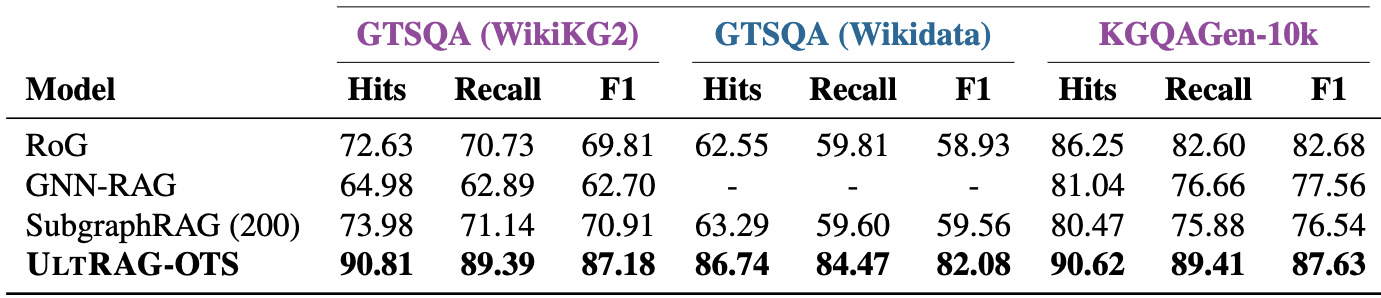
Knowledge graphs are an efficient and easily verifiable repository of factual information and using knowledge graph queries as a tool for LLMs to improve the factuality of their output is a promising direction. But have you ever wondered how to make query execution work for knowledge graph RAG? "No!"/"Boring!" Let us guess — queries were flawed, knowledge graphs incomplete, results were simply suboptimal. What if we tell you that we have discovered a secret... recipe.

December Papers: MoE, Fact-storing and Byteifying Language Models

Despite the holiday season and the busy NeurIPS period, December closed the year with set of insightful papers. Our team reviewed the following three papers:

  • First up, SonicMoE tackles issues of fine-grained and sparse MoEs using hardware-aware optimizations to restore efficiency.
  • Finally, Bolmo presents a method for "byteifying" existing subword-level language models that improves character-level understanding while achieving comparable performance to subword-level models.

November Papers: Perspectives on efficiency

November is back to a favourite topic of ours: efficiency. We reviewed three of our favorite papers looking on LLM efficiency from different angles:

  • First up, How to Scale Second-Order Optimization is looking at optimal tuning of second order optimizers such as Muon.
  • Intelligence per Watt discusses our favorite metric on large language models: energy efficiency. And how to take advantage of edge AI inference.
  • Finally, Int vs FP is contributing to an old-timer topic in quantization: integer vs floating (block) point formats.

Why Graph Topology Matters: Insights from Applications in Drug Discovery

Knowledge Graphs in Drug Discovery

Repurposing existing drugs to treat diseases beyond what they were originally designed for can be a way to identify new disease treatment opportunities. But how do we identify which drugs might affect a given disease? This and similar questions in drug discovery, which require identifying new links between known entities, can be addressed with the help of Knowledge Graphs (KGs), graph-structured repositories of information that represent facts as (head, relation, tail) triples, connecting entities head and tail with an edge that categorizes their relationship. In the biomedical domain, entities can represent drugs and diseases, but also genes, pathways, side effects, etc. KG edges represent interactions like (disease A, associates, gene B), (gene X, upregulates, gene Y) and many more.

October Papers: Fast and Smart Language Models

October was packed with insights into making language models faster and smarter. We reviewed four of our favorite papers for you in detail:

  • First up, Grouped Lattice Vector Quantisation introduces a novel technique for a fine-grained post-training quantisation of LLMs, retaining good performance even at low bit widths.
  • Planned Diffusion combines autoregressive planning with text diffusion, achieving low-latency text generation.
  • Rethinking Thinking addresses the problem of long reasoning chains by distilling intermediate results into a bounded workspace for faster answers.
  • Finally, When Structure Doesn’t Help compares techniques for encoding graphs for consumption by LLMs with surprising results.

September Papers: The L in ML Stands for LLMs

For September, the research team reviewed a whopping 22 papers! Needless to say, competition was fierce, and only four made the final cut for this month’s edition, which is LLM-themed:

  • FlowRL uses GFlowNets to train LLMs on full reward distributions, promoting diverse reasoning paths instead of just reward maximization.
  • Soft Tokens, Hard Truths proposes using continuous “soft” tokens with injected noise to enable reinforcement learning fine-tuning of LLM reasoning.
  • Set Block Decoding accelerates LLM inference by generating multiple tokens in parallel using non-causal attention and iterative entropy-based sampling.
  • Metacognitive Reuse enables LLMs to extract and reuse concise reasoning “behaviors” to improve efficiency and reduce repeated computation.

August Papers: Optimal Dataset Mixtures, Stable Molecule Generation, and Agentic Hypergraph RAG

August, even with its heat waves and holidays, left no shortage of exciting research. Our top papers for this month are the following: - ADMIRE-BayesOpt that investigates how to weight different data sources when they are mixed to make a single training dataset where, using multi-Fidelity Bayesian Optimization, the search for the optimal mixture can be automated; - Stable Molecule Generation that uses a force-field based reward function to fine-tune pre-trained 3D molecule generation diffusion models with the goal of sampling physically stable and valid molecules; and - Graph-R1 that takes an agentic RAG approach with a knowledge hypergraph to effectively represent and retrieve information from a corpus of documents.

July Papers: Subliminal Learning, Mixture of Recursions and Dataset Curation

As July brought tennis at Wimbledon, so too did the ML world serve up a volley of research. This month, we took an eagle-eyed approach—or, perhaps, Hawk Eyed approach—to three papers.

In our first paper, Subliminal Learning addresses the question, "Can we control or filter the distillation training data so that a student learns desirable properties but avoids picking up undesirable traits?" The authors conclude that the student learns all the teacher's traits, whether they're desirable or not!

Next, Mixture of Recursions brings a twist to token-level computation: instead of fixed-depth processing, the model learns to recurse adaptively, allocating compute per token dynamically and efficiently—like a rally whose length depends on the importance of the point.

Last up is DataRater, where the problem of dataset quality is addressed. A 'rater' is meta-learned to curate training data without manual filtering—an ace for data-centric AI.

June Papers: Gradient Norms, LLM Reasoning and Video Generation

This June not only brought us very hot and sunny days (at least here in the UK), but also an excellent selection of new and exciting ML research! Out of the many good candidates, this month we selected three papers, covering quite a lot of different ground.

In the first paper, Why Gradients Rapidly Increase Near the End of Training, a researcher from FAIR explores the puzzling phenomenon of increasing gradient magnitudes during training, offering an elegant mathematical explanation and a simple remedy.

Next, in ProRL, NVIDIA researchers dive into the evolving topic of large language model reasoning, showing how prolonged reinforcement learning can indeed introduce novel reasoning abilities.

Finally, we look at AAPT, a fresh approach from the ByteDance Seed team that turns pre-trained offline diffusion models into real-time video generators via adversarial post-training.