
Getting Started
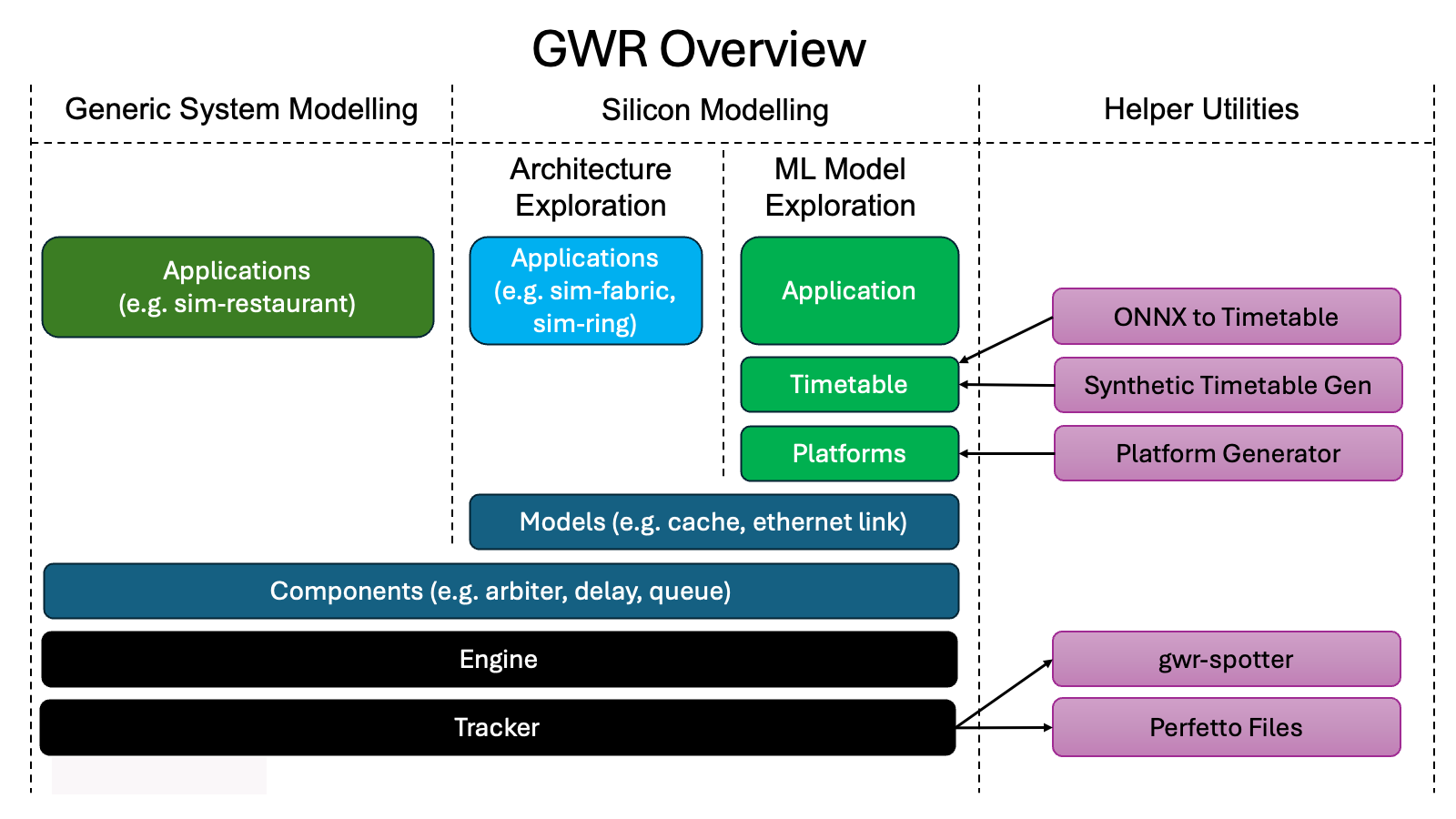
Welcome to the GWR project. The core GWR packages are developed as a monorepo, which together provide the following functionality:
- An event-driven simulation engine.
- Logging and log viewing system.
- Hierarchical configuration support.
- Documentation tooling.
- A library of components and basic models.
- A set of application examples.
Simple simulation example
This example shows how the GWR engine and components can be used to create a simple simulation. This simulation connects a source, which will transmit 10 objects, to a sink, which counts the number of objects it receives.
use gwr_components::sink::Sink;
use gwr_components::source::Source;
use gwr_components::{connect_port, option_box_repeat};
use gwr_engine::engine::Engine;
use gwr_engine::run_simulation;

fn main() {
  let mut engine = Engine::default();
  let clock = engine.default_clock();
  let mut source = Source::new_and_register(&engine, engine.top(), "source", option_box_repeat!(0x123 ; 10));
  let sink = Sink::new_and_register(&engine, &clock, engine.top(), "sink");
  connect_port!(source, tx => sink, rx)
      .expect("should be able to connect `Source` to `Sink`");
  run_simulation!(engine);
  assert_eq!(sink.num_sunk(), 10);
}
Why GWR?
GWR aims to provide a complete modelling workflow, supporting silicon chip and system architecture projects from the initial exploration phase, through more detailed evaluations, and finally to a full specification and golden reference quality model.
Async language features are utilised to allow expressive description of physical world parallelism. An asynchronous runtime executor is included within the gwr-engine package for this purpose, which supports both event-driven and clocked modelling.
GWR is designed with scalability in mind, with the aim being to enable both high accuracy/detailed simulations and large scale simulations in a tractable timeframe. To meet this goal it is therefore important that both the development of models using GWR, as well as the execution of these models is efficient. A developer guide covering the use of the GWR for modelling, as well as API documentation for each package is included. The general philosophy adopted is to raise errors as early as possible for developers, so as many as possible will be at compile time rather than run time, as well as to guard against common errors such as unconnected or misconnected model components where possible.
Built-in support for external documentation tooling allows for the creation of a single source of truth which contains both the readable specification and the executable model. Where appropriate sections of specification and the reference model for that part of the specification can reside within the same source file if desired.
Continuous integration is run on both Linux (Ubuntu LTS) and macOS to ensure ongoing compatibly with whichever platform developers wish to use. A robust release process is also defined to guarantee semantic versioning of packages and automated generation of release notes ensuring user upgrade processes are as smooth as possible.
GWR is written in Rust and takes advantage of a number of the features it offers. In brief summary these are the strong typing system and emphasis on correctness in Rust, excellent and easy to use tooling and build system, and excellent runtime performance (which we have found to be on a par with C++). More information on this, and guides to help get started with the language are included in the Rust chapter of the developer guide.